

EOT Claims in Construction: A Step-by-Step Guide


Written by the consulting team at Protecon BTG, which supports infrastructure, railway and oil & gas projects across India and the UAE with PMO, project controls, contract management and claims services.
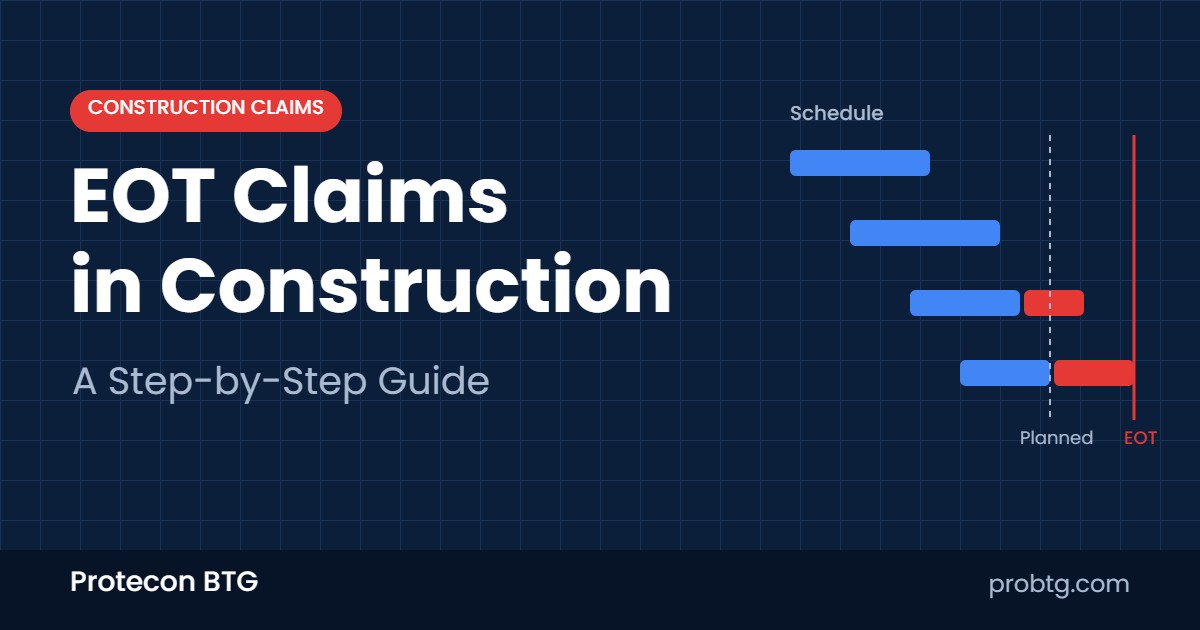
An Extension of Time (EOT) claim is a contractor’s formal request for more time to finish a project when delays happen that are not the contractor’s fault. If the claim is accepted, the completion date moves, and the contractor is protected from liquidated damages (LDs) for that period.
On large infrastructure, railway, metro and EPC projects in India, delays are almost certain. Late drawings, land not handed over on time, design changes, approvals stuck with authorities and extra work all push the schedule. Yet many genuine EOT claims are rejected or reduced because they are submitted late, poorly documented or not backed by a proper delay analysis.
This guide explains, step by step, how to prepare an EOT claim that holds up, and the mistakes that most often sink one.
What is an EOT claim?
An EOT claim asks for more time. It is based on the contract’s extension of time clause and must show that a specific event delayed the completion date, and by how many days.
When are you entitled to an EOT?
You are usually entitled to an EOT when the delay is excusable, meaning it was caused by the employer or by an event the contract puts at the employer’s risk, and it affects the completion date. Your contract’s EOT clause is the final word, so always read it first.
| Type of delay | Examples | EOT? | Extra cost? |
|---|---|---|---|
| Employer-caused | Late site or land handover, late drawings or approvals, design changes, variations, suspension orders | Yes | Usually yes |
| Neutral events | Force majeure, exceptionally adverse weather, change in law (as defined in the contract) | Usually yes | Usually no |
| Contractor-caused | Late mobilisation, poor productivity, shortage of labour or material, subcontractor failure | No | No |
Two tests matter for almost every claim:
- Critical path: the event must delay activities on the critical path, not just any activity. A delay to an activity with float may not move the completion date.
- Concurrency: if your own delay ran at the same time as the employer’s delay, the claim gets more complex. Many contracts and tribunals still grant time but not money in such cases.
How to prepare an EOT claim: step by step
- Give notice on time. Most contracts require written notice within a fixed period of the delay event, often 14 to 28 days. Missing this deadline is the most common reason claims fail, so send a short notice first and the detailed claim later.
- Keep contemporaneous records. Record the event as it happens: site diaries, daily progress reports, correspondence, minutes of meetings, photos, drawing registers and RFI logs. Records made at the time carry far more weight than ones rebuilt later.
- Update the programme. Keep an approved baseline schedule and regular updates in Primavera P6 or MS Project. Without a reliable baseline and updates, it is very hard to prove what the delay actually did to the completion date.
- Carry out a delay analysis. Show, with a recognised method, how each event moved the critical path and by how many days (see the methods below). This is the technical core of the claim.
- Prepare the claim document. Set out the contract clauses relied on, a clear narrative of each event, the delay analysis, the days claimed, and supporting documents cross-referenced in an appendix.
- Submit and follow up. Submit within the contract timeline, track the response, answer the engineer’s queries promptly, and keep updating the claim if the delay is still continuing.
- Escalate if needed. If the claim is rejected, follow the contract’s dispute route, such as negotiation, a Dispute Adjudication or Review Board (DAB/DRB), and finally arbitration. A well-built claim at step 5 is what wins at this stage.
If you also want money for the delay (prolongation costs, idle resources, extended overheads), prepare that as a separate, linked cost claim. Our construction claims and arbitration team supports both.
Delay analysis methods, explained simply
The right method depends on the records you have and when the analysis is done. International guidance such as the SCL Delay and Disruption Protocol and AACE’s forensic schedule analysis practice describes these methods in detail.
| Method | How it works | Best when |
|---|---|---|
| As-planned vs as-built | Compares the original plan with what actually happened | Simple projects with limited schedule data |
| Impacted as-planned | Adds delay events to the baseline programme and measures the shift | Early claims, but often criticised as theoretical |
| Time Impact Analysis (TIA) | Inserts each delay event into the latest updated programme at the time it occurred | Prospective EOT claims during the project |
| Windows analysis | Splits the project into time windows and measures critical delay in each | Long projects with regular programme updates |
| Collapsed as-built | Removes employer delays from the as-built programme to show when work would have finished | Retrospective claims with good as-built records |
For most live projects, a Time Impact Analysis in Primavera P6 is the most persuasive approach, because it shows the effect of each event at the time it happened. Our project controls and scheduling team prepares these analyses.
Common mistakes that get EOT claims rejected
- Late or missing notice: the claim may be time-barred, even if the delay was genuine.
- No approved baseline programme: without it, there is nothing to measure the delay against.
- Global claims: lumping all delays together without linking each event to its effect on the critical path.
- Weak records: relying on memory or documents prepared months later instead of site records made at the time.
- Ignoring your own delays: not addressing concurrent contractor delay makes the whole analysis look one-sided.
- Claiming days, not proving them: stating a number of days without a recognised delay analysis to support it.
- Waiting until the end: a claim submitted only at project completion is harder to prove and easier to reject.
How Protecon BTG helps with EOT claims
Protecon BTG supports contractors and employers with cost and time-related construction claims across India and the UAE. Our team has provided techno-legal claims and arbitration support, including expert testimony on delay and quantum.
- Contemporaneous record and notice management through our contract management services
- Baseline programmes, updates and Time Impact Analysis in Primavera P6
- EOT and prolongation cost claim preparation
- Support through DRB proceedings and arbitration hearings
Facing a delay on your project? Talk to our claims team: call +91 9311671671 or email Info@probtg.com.
Frequently asked questions
What is the difference between an EOT claim and a delay cost claim?
An EOT claim asks for more time and protects you from liquidated damages. A delay or prolongation cost claim asks for the extra money the delay cost you. They are often prepared together but proven separately.
How soon should I notify the employer of a delay?
As soon as you become aware of it, and always within the period your contract sets. Send a short notice first and follow it with the detailed claim.
Can I get an EOT if my own delay happened at the same time?
Often yes, depending on the contract. Concurrent delay commonly results in an extension of time but no additional payment for that period.
Which software is used for delay analysis?
Primavera P6 is the most widely used for large projects, with MS Project used on smaller ones. The analysis is only as good as the baseline and progress updates behind it.
What happens if the engineer rejects my EOT claim?
You can follow the dispute resolution route in your contract, such as negotiation, a DAB or DRB, and finally arbitration.

Hi, This was really well informed and formatted article, easy to go through